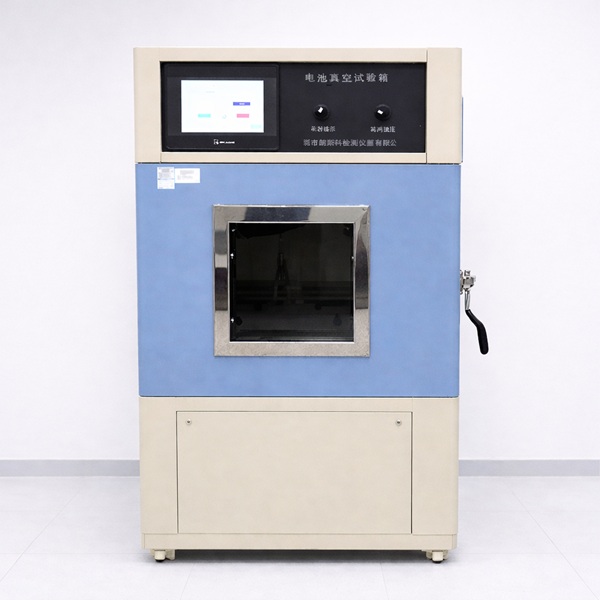
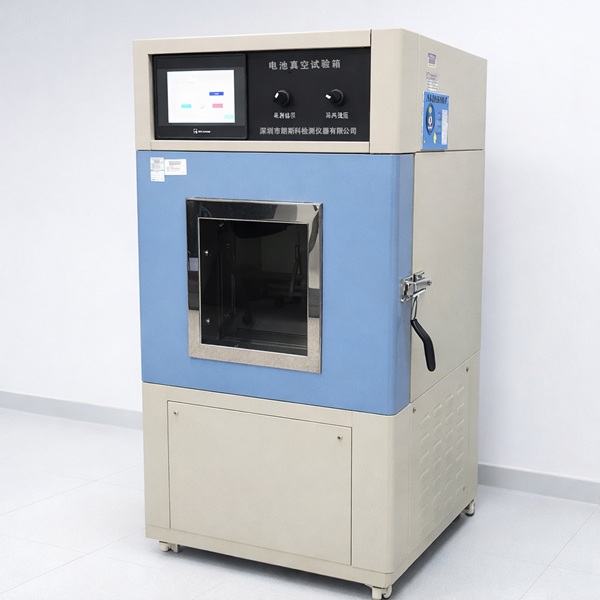
Model:LSK-GZX
Battery High-Altitude (Low-Pressure) Simulation Test Chamber
Designed in compliance with relevant standard requirements, this chamber meets the specifications of GB/T 18332.2-2001, IEC 62133:2002, EN 62133:2003, UN38.3, UL 2054, UL 1642, QC/T 743-2006, as well as the Performance Test Specification for Lithium-ion Traction Batteries for EVs under the Major Project of Energy Conservation and New Energy Vehicles of the 863 Program. It simulates the storage state of batteries in the low-pressure environment (11.6kPa) that may be encountered during high-altitude transportation.
The Battery High-Altitude (Low-Pressure) Simulation Test Chamber is
designed in accordance with applicable standards, including GB/T 18332.2-2001, IEC 62133:2002, EN 62133:2003, UN 38.3, UL 2054, UL 1642, QC/T 743-2006, as well as the performance test specification for EV lithium-ion traction batteries under the national “863 Program” major project for energy-saving and new energy vehicles.
It is used to simulate the low-pressure storage condition (11.6 kPa) that batteries may encounter during high-altitude transportation, in order to evaluate battery performance and safety under such environments.

Main Features of the Equipment
The battery high-altitude (low pressure) simulation test chamber is designed in accordance with test standard requirements. The battery high-altitude simulation testing machine can quickly bring the sample to a low-pressure storage state, automatically control the test cycle, monitor the pressure changes inside the chamber throughout the process, and realize automatic test termination. The entire equipment consists of three parts: the outer chamber, the inner liner and the vacuum pumping system.
The outer chamber is made of high-quality thin steel plates with a powder-coated surface. The inner liner is made of stainless steel plates and has a cuboid inner cavity. The chamber door is equipped with a double-layer laminated glass observation window for easy viewing of items inside the chamber, and a long cylindrical door latch to adjust the distance between the door and the glass, ensuring the rubber sealing ring is compressed when the door is closed to prevent air leakage during vacuuming.
The vacuum pumping system is composed of a vacuum pump, a vacuum gauge, an electromagnetic vacuum valve and a balance port. The vacuum gauge adopted in this product features an optimized design for automatic and precise vacuum degree control, with customizable vacuum gauge functions and zone control method applied. The safety protection devices include earth leakage protection switch and fuse.
Technical Parameters of Battery Low Pressure Testing Machine
Outer chamber material: A3 steel plate with baking finish
Inner chamber material: Stainless steel
All connecting pipes: Special steel
Storage partition: Stainless steel
Automatic control of air intake and output, automatic constant pressure control
Chamber door sealing: High temperature resistant silicone sealing ring
Safety observation glass: Tempered glass observation window on the chamber door for clear internal viewing
Safety device: Built-in pre-overpressure safety device with pressure reducing valve for overpressure protection
Alarm function: Triggered in case of misoperation or timing end
Power supply voltage: 3-phase, 380V 50HZ 20A
Standard configuration: 1 vacuum chamber, 2 standard storage racks, 1 vacuum pump
Temperature range: Achieved by controlling the laboratory internal temperature; the laboratory temperature must reach (20℃±5℃) to ensure the temperature inside the test chamber falls within this range.
Vacuum degree: 133Pa (Pa); Pointer-type vacuum degree control meter with a minimum pressure range of 1kPa, commonly used at 11.6KPA
Working chamber dimension (D×W×H): 400×400×350mm (customizable)
Overall dimension (D×W×H): 430×710×960mm (customizable)
Timing range: 0-99999 minutes (min)
Weight: 110 kilograms (kg)