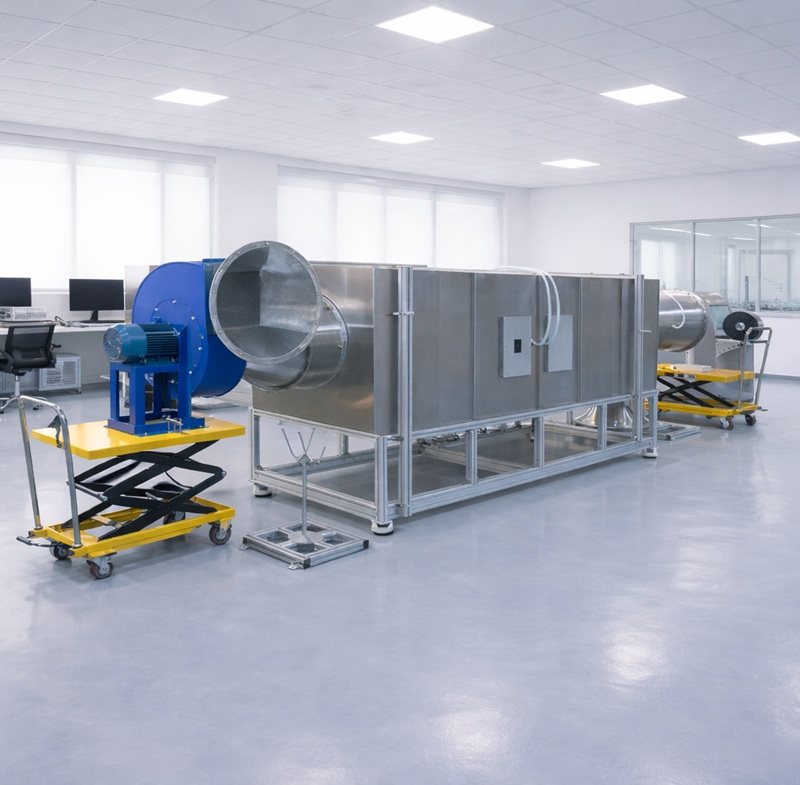
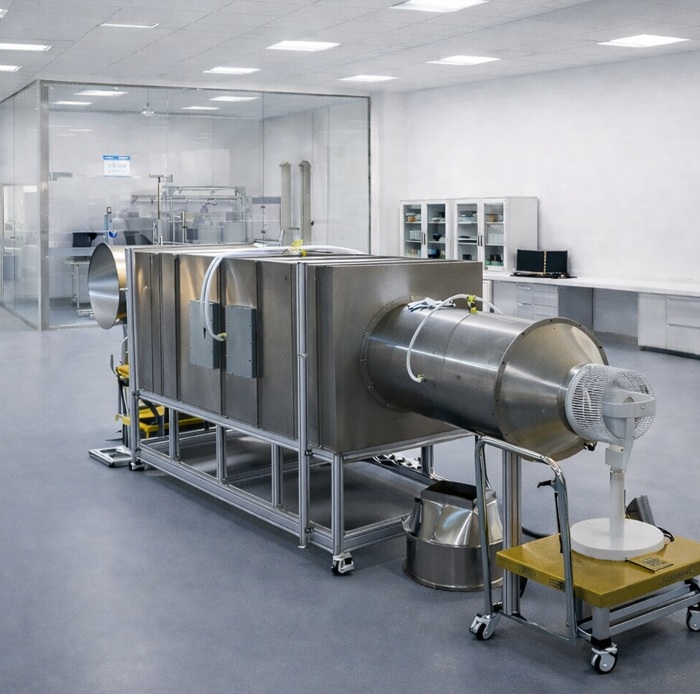
Model:LSK-T1500
The airflow measurement system complies with GB/T 1236, GB/T 17713, ISO 5801, IEC 61591, IEC 60665, GB/T 14806, JIS B 8330, JIS C 9603, and other relevant standards. It is applicable to performance testing of ventilation fans, air conditioners, cooling fans, range hoods, etc., without any hardware or software modifications.
Airflow Measurement Test System
The airflow measurement test system complies with GB/T 1236, GB/T 17713, ISO 5801, IEC 61591, IEC 60665, GB/T 14806, JIS B 8330, JIS C 9603, and other relevant standards. It can be used for performance testing of ventilation fans, air conditioners, cooling fans, range hoods, etc., without any hardware or software changes.

Key Features
Multi-nozzle wind-chamber structure: The appropriate nozzle can be selected according to the measured flow rate, enabling a wide measurement range with one system.
Dual-mode testing: Suitable for both blowing (discharge) and suction (inlet) tests.
Equipped with an auxiliary fan: Enables measurement of full-range performance curves, including conditions of zero airflow and zero static pressure.
Fully automated testing & reporting: Automatic test control, calculation, data output, graphical display, and printing via PC. Simple HMI operation, high accuracy, time- and labor-saving.
Test items:
P–Q characteristic (airflow vs. static pressure)
Q–η characteristic (airflow vs. efficiency)
Simultaneous measurement of the DUT’s speed (rpm), current, power, etc.
Test Principle
Developed based on IEC standards and advanced Japanese technology.
Principle: The DUT’s actual operating condition is simulated in the test wind tunnel (the auxiliary fan is used to match the outlet pressure to the required condition). The pressure differential across the nozzle is measured, the corresponding air velocity is calculated using standard formulas, and the airflow is obtained by multiplying by the nozzle area and the relevant flow coefficient.
Applicable Products
Performance testing for ventilation fans, air conditioners, cooling fans, range hoods, etc. (no hardware/software modification required).
Overall Proposal
This proposal does not include the laboratory building/civil construction; the user shall build it according to the standard requirements.
1. General Laboratory Requirements
For the range hood air performance test device, the orifice-plate method is used to test the rated airflow, rated pressure, and efficiency. During testing, the operator manually replaces the orifice plate; the computer automatically collects pressure, temperature, and power data, processes the results, and prints the test report.
Room size: ≥ 4500 (W) × 6000 (L) × 2800 (H) mm
Walls: Smooth and flat; no openings affecting airflow (air-conditioner outlets shall not blow directly into the test section).
Floor: Keep level.
2. Test System
2.1 Main Components
Airflow test wind tunnel
Auxiliary fan and damper adjustment mechanism
Measurement & control electrical cabinet (including VFD power supply, electrical parameter meter, pressure transmitter, tachometer, etc.)
Branded PC
Printer
DUT lifting platform
DUT mounting flange and test ducting
2.2 System Functions
After the computer prompts the user to input DUT parameters and test data, the system performs fully automatic measurement and control, including:
Airflow measurement
Voltage / current / power measurement
Speed (rpm) measurement
Temperature / humidity / atmospheric pressure measurement
Test process prompts
Data tables and related curves
2.3 Power Supply Requirement
The user shall provide an independent distribution switch.
Three-phase, four-wire + PE (ground): AC 380 V, 50 Hz; max. capacity: 5 kVA
3. Test Software
Windows-based (Windows 10), window interface, Chinese display.
Collects all measured data and provides real-time continuous monitoring in numeric and tabular formats.
After the test, automatically performs statistical analysis/processing of raw data, displays and prints test results.
Historical data query by test date, ID, model, etc., with display and printing.
Interface and related data can be customized/modified according to user requirements.
Technical Specifications
Lab power: AC 220 V / AC 380 V, 50 Hz; 5 kVA
Environment: 20 ℃ ± 5 ℃; 30%–80% RH; atmospheric pressure: normal
Airflow measurement range (depending on nozzle configuration):
0.06–25 m³/min
0.2–50 m³/min
Static differential pressure: 0–1250 Pa, accuracy ±0.1%
Electrical parameters: voltage/current/power accuracy Class 0.5, digital display
Voltage range: AC 0–300 V
Speed: digital display 0–19999 rpm, ±5 rpm
Air temperature: 0–100 ℃, ±0.5 ℃
Air humidity: 20–98% RH, ±4%
Variable-frequency regulated power supply:
Input: AC 220 V, 50 Hz
Output: AC 0–110–220–300 V, continuously adjustable, ≤1%
Operating point testing: automatic adjustment (replacing the original 18 throttling/orifice plates)
Automatically Calculated Items (Operating Condition)
Indicated static pressure in the pressure-reducing chamber: Ps6 (Pa)
Input electrical power: P (W)
Airflow at test condition: Qv (m³/s)
Total pressure at test condition: Pfb (Pa)
Total pressure at standard air condition: Pfbn (Pa)
Static pressure at test condition: Ps2n (Pa)
Total pressure efficiency at test condition: η (%)
Automatically Generated Results After Testing
Maximum static pressure (static pressure at zero airflow): Ps2n(max) (Pa)
Maximum airflow (airflow at zero static pressure): Qv(max) (m³/min)
Static pressure at specified airflow (7 m³/min): Ps2ns (Pa)
Main motor input power at specified airflow (7 m³/min): P (W)
Total pressure efficiency at specified airflow (7 m³/min): η (%)
Curve Plotting & Test Modes
The system can plot curves of:
Static pressure vs. airflow
Airflow vs. speed/current/power/efficiency, etc.
It also supports testing the DUT in both inlet (suction) and outlet (discharge) modes.
(Keywords: range hood airflow chamber / range hood airflow test room / ventilation fan airflow chamber / airflow measurement system)