

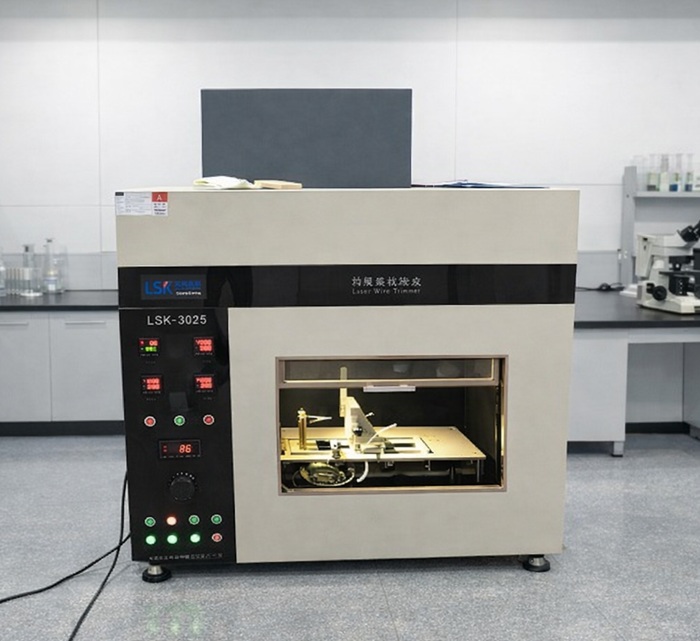
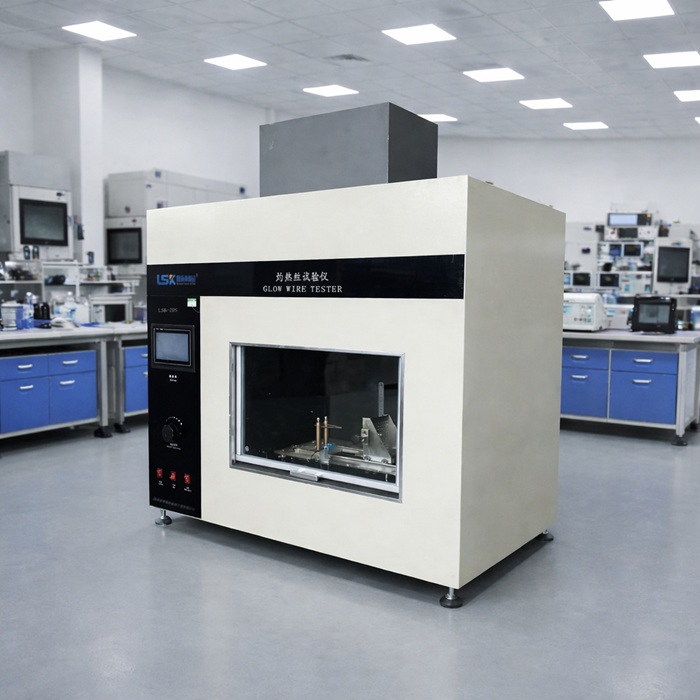
This equipment is applicable to electrical equipment and its components/parts, as well as solid electrical insulating materials and other solid combustible materials. Using simulation techniques, it evaluates the risk of ignition caused by thermal stress generated in a short time by heat sources such as glowing elements or overload resistors.
An electrically heated glow wire is used as the ignition source. The ignition test is conducted on test specimens of solid electrical insulating materials or other solid materials to determine the Glow-Wire Flammability Index (GWFI).

2. Standards
2.1 Complies with GB/T 5169.10-2017 and IEC 60695-2-10:2013, Fire hazard testing for electrotechnical products – Part 10: Glow-wire/hot-wire based test methods – Glow-wire apparatus and common test procedure.
2.2 Complies with GB/T 5169.11-2017 and IEC 60695-2-11:2014, Fire hazard testing for electrotechnical products – Part 11: Glow-wire/hot-wire based test methods – Glow-wire flammability test method for end-products.
2.3 Meets the requirements of Clause 28.1.1 of GB 2099.1-2008 and IEC 60884-1:2006, Plugs and socket-outlets for household and similar purposes – Part 1: General requirements.
2.4 Meets the requirements of Clause 13.3.2 of GB 7000-2015 and IEC 60598-1:2014, Luminaires – Part 1: General requirements and tests.
3. Key Features
3.1 Low-voltage, high-current transformer power supply is adopted, which significantly extends the service life of the glow wire and effectively improves temperature stability.
3.2 Adopts PLC + P.I.D + SSR control, providing high temperature-control accuracy, low fluctuation, and excellent stability.
3.3 Human–machine interface: a touchscreen operation panel with user-friendly and intelligent design, enabling easy and fast operation. Supports a large number of programs with simplified “one-touch” operation.
3.4 An isolation transformer is used in the control circuit, keeping the glow-wire working voltage below 12 V, effectively ensuring operator safety.
3.5 Glow-wire device adopts an automated control system.
4. Main Performance Parameters
4.1 Test Chamber
Volume: 0.5 m³
Material: Steel plate, finished with high-temperature electrostatic baking paint
Functions: Internal lighting and exhaust; interior painted black; illuminance on the specimen ≤ 20 lx
4.2 Glow Wire
Ring-shaped resistance wire made of Ni/Cr (80/20) with nominal diameter 4.0 mm
4.3 Glow-Wire Heating Current
When the tip is heated to 960°C, the current is 120 A to 150 A
4.4 Force Applied to Specimen
1.0 N ± 0.2 N
4.5 Penetration Depth into Specimen
7.0 mm ± 0.5 mm